High-alumina mullite bricks are classified into lightweight and heavyweight types.
Heavyweight high-alumina mullite bricks are high-alumina refractory bricks with mullite as the main crystalline phase. The alumina content is between 65% and 75%. The mineral composition includes mullite. Generally, the bulk density is above 2.5.
Mulite bricks are further divided into sintered mullite bricks and fused mullite bricks. Sintered mullite bricks are made from high-alumina clinker as raw material, with clay added as a binder, and then molded and fired. Fused mullite bricks are made from alumina and refractory clay as raw materials, using a reduction electrofusion method for casting. Fused mullite crystals are larger than sintered mullite, resulting in better thermal shock resistance.
High-alumina lightweight mullite bricks are a type of thermal insulation refractory material with a uniform structure and low thermal conductivity. Their bulk density is between 1.0 and 1.5, and they have broad market prospects. Lightweight high-alumina mullite bricks, also known as mullite lightweight bricks, have a high operating temperature and can be directly exposed to flames, resulting in significant energy savings.
There are several methods for producing lightweight high-alumina mullite bricks: the foaming method, the additive burnout method, and the gasification method. During use, they are cut to the required dimensions with precision.
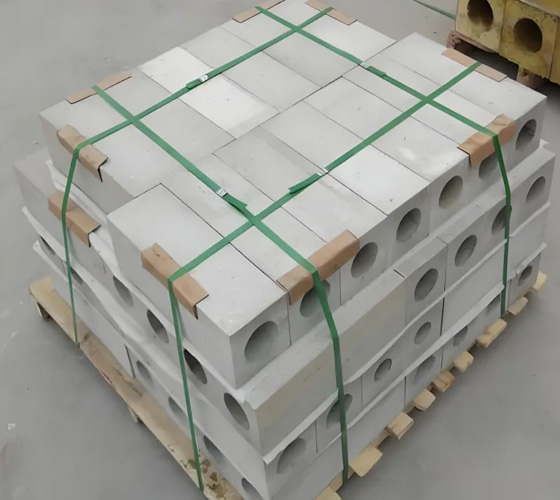
Currently, there are three types of high-alumina mullite bricks on the market. One type is made primarily of bauxite with added mullite, formed and sintered, and used in areas with temperatures above 1400℃. Another type is electrofused mullite bricks made by casting, used for the bottom of glass kilns. The third type is lightweight high-alumina mullite bricks, which are lightweight and perform well. They can be used for insulation and as working layers in some special kiln linings, allowing direct contact with flames.
Which has a larger coefficient of thermal expansion, corundum bricks or mullite bricks?
High-temperature expansion of refractory bricks refers to their high-temperature performance, while the coefficient of thermal expansion refers to the relative change in temperature of the refractory brick.
Both corundum bricks and mullite bricks are high-grade materials in the refractory materials field and belong to the alumina series. Comparatively, corundum bricks have a smaller coefficient of thermal expansion than mullite bricks.
Corundum bricks have a high melting point, stable high-temperature performance, and good wear resistance.
Mulite bricks are similar to high-alumina refractory bricks. There are two types of mullite: one is mullite formed at high temperatures from clinker with high alumina content; the other is mullite bricks made by adding mullite and then molding and firing at high temperatures. Especially refractory bricks with added mullite, sintered at temperatures above 1700℃, can form a protective film at high temperatures and have good flexibility.
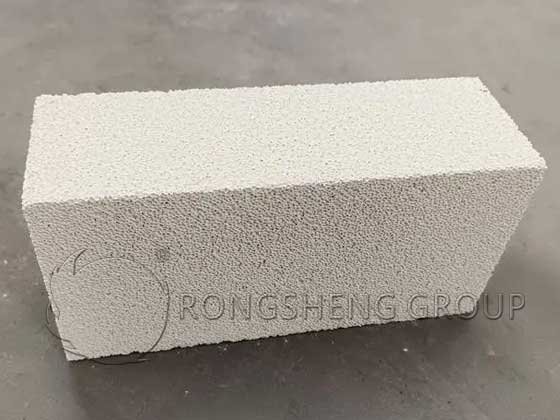
Corundum bricks and mullite bricks have different coefficients of thermal expansion.
Refractory bricks expand in volume when heated, but the coefficient of thermal expansion varies depending on the mineral composition. Clay bricks, high-alumina bricks, and magnesia bricks have relatively large coefficients of thermal expansion. However, silica bricks, due to polycrystalline transformation, have an even larger coefficient of expansion.
A higher coefficient of thermal expansion makes it more difficult to control the dimensions of the refractory bricks and also affects their thermal stability. A higher coefficient of thermal expansion also results in greater internal stress when the refractory bricks are heated, making them more susceptible to damage during rapid temperature changes.
The coefficient of thermal expansion is one of the important indicators of refractory bricks. A smaller coefficient of expansion means less volume change caused by crystallization, crystal transformation, and continuous sintering at high temperatures.
Refractory bricks change volume due to temperature variations during use. This significantly affects the dimensional compactness of the refractory bricks. Generally, expansion joints should be left during refractory brick installation, depending on the type of brick. If the coefficient of thermal expansion is too large and not addressed promptly, the expansion of the bricks can cause cracks in the furnace body, affecting its use.
Rongsheng Mullite Brick Manufacturer
In Rongsheng Kiln Refractory Manufacturer, there are many types of refractory bricks, each with a different coefficient of thermal expansion. Comparing corundum bricks and mullite bricks, corundum bricks have a smaller expansion rate than mullite bricks. Lightweight mullite insulating bricks solve the problems of heavyweight and poor insulation performance of traditional refractory materials, making them an ideal choice for fire resistance, insulation, and high-temperature stability!
Mullite Lightweight Insulating Bricks Solutions
The shortcomings of traditional refractory materials and their solutions with mullite lightweight insulating bricks.
-
The Weight Problem of Traditional Refractory Materials
Traditional heavy refractory bricks place a heavy burden on equipment, increasing load-bearing requirements and potentially leading to structural deformation or even damage. For example, in the export process of ceramic kilns, the use of heavy refractory bricks makes the kiln structure thicker and increases the unit volume weight of segmented kilns, exceeding the load-bearing limit of containers. Transportation and installation become extremely inconvenient. Mullite lightweight insulating bricks easily solve this problem. They can be flexibly applied to equipment with various structures, and even heavy equipment with high load-bearing requirements can achieve better performance due to their lighter weight and higher compressive strength.
-
Energy Waste Due to Poor Insulation
Some traditional refractory materials have poor insulation, leading to significant heat loss. This represents a huge energy loss and economic expense for enterprises. Taking ceramic firing as an example, if the insulation material is inadequate, heat will dissipate rapidly within the kiln. To ensure firing quality, continuous heat replenishment is necessary, increasing fuel consumption. Mullite lightweight insulating bricks, with their excellent insulation properties, effectively prevent heat loss, reduce energy waste, and save businesses considerable costs.
-
Reliability of Insulation Materials at High Temperatures
In high-temperature environments, many traditional refractory materials experience performance degradation, such as cracking, spalling, and shrinkage. This not only affects the insulation effect but may also cause further damage to kiln equipment. The high-temperature stability of mullite lightweight insulating bricks ensures their reliability at high temperatures, preventing these problems from occurring with increasing temperatures. This guarantees long-term stable operation of equipment and reduces maintenance costs and downtime due to material failure.
With its lightweight, excellent insulation performance, and high-temperature stability, mullite lightweight insulating bricks perfectly solve the pain points of traditional refractory materials in terms of weight, insulation effect, and high-temperature reliability. It has become an indispensable and ideal choice for many customers when selecting high-temperature insulating materials.