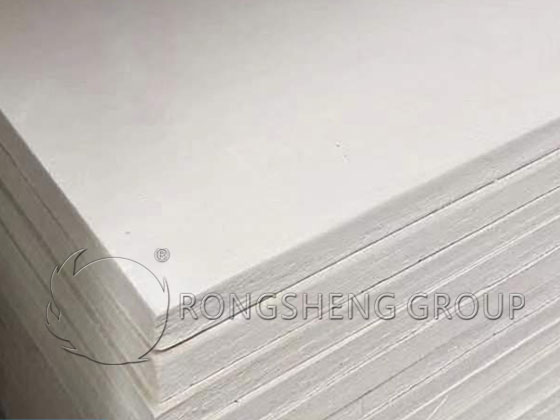
Ceramic fiberboard, also known as aluminosilicate fiberboard, is a type of refractory material board. It is a rigid board product made by adding appropriate amounts of organic binders and inorganic adhesives to loose ceramic fibers, followed by vacuum forming, drying, and finishing. It has advantages such as good thermal stability, high temperature resistance, and low thermal conductivity, and is therefore widely used in many industries.
Characteristics of Ceramic Fiber Boards
The terminology for refractory ceramic fiber boards is clearly defined in GB/T18930-2002, “Terminology for Refractory Materials.” The definition is as follows: Ceramic fiber boards generally refer to rigid, flat refractory ceramic fiber products containing inorganic or organic binders and produced using a wet process. The binder refers to a substance added to non-plastic granular or fibrous materials to give them workability and green or dry strength. Refractory ceramic fibers refer to man-made mineral fibers suitable for use as insulation materials above 800℃. Rongsheng ceramic fiber board for sale. Ceramic fiber boards possess the following six characteristics:
-
Grading Temperature
Grading temperature refers to the highest temperature at which the linear shrinkage rate is less than a given value. This temperature is expressed in °C and is in 50℃ increments. According to GB/T17911-2006, the permanent linear shrinkage rate of refractory ceramic fiber products upon heating, when measured according to the permanent linear shrinkage test, is no more than 2% for refractory ceramic fiber boards and irregularly shaped rigid products. This is the grading temperature. In GB/T3003-2006, “Refractory Materials, Ceramic Fibers and Products,” the grading temperature of ceramic fibers and products is divided into 19 levels, starting from 850℃ and ending at 1750℃.
Grading temperature characterizes the heat resistance of refractory ceramic fiber boards and is the most basic performance indicator to ensure the correct use of refractory ceramic fiber boards.
-
Bulk Density
Bulk density refers to the ratio of the dry mass of a ceramic fiber board to its total volume. Generally, the bulk density of ceramic fiber boards ranges from 260 to 480 kg/m³. GB/T3003-2006, “Refractory Materials, Ceramic Fibers and Products,” specifies eight nominal bulk density values for ceramic fiber boards: 260, 280, 300, 320, 330, 360, 400, and 450 kg/m³.
-
Compressive Strength
This refers to the ultimate load that a rigid ceramic fiber product can withstand per unit area at room temperature. Compressive strength is one of the important performance indicators for evaluating the quality of rigid ceramic fiber products. It can indirectly reflect the product’s microstructure, such as density, uniformity, and sinterability.
-
Permanent Linear Changes Due to Heating
The linear expansion or contraction of refractory materials after heating to a specified temperature, holding for a certain time, and cooling to room temperature without external force is considered. Domestic and international research results indicate that the linear shrinkage test for ceramic fiber products requires a 24-hour holding period. After 24 hours of holding, the linear shrinkage rate of ceramic fiber products reaches over 75% of the long-term shrinkage rate. The results of the 24-hour holding period linear shrinkage test can characterize the permanent linear changes due to heating during long-term use.
The linear shrinkage of ceramic fibers due to heating is meaningless for individual fibers; it only relates to the ceramic fiber product and is directly related to fiber crystallization and grain growth. Before crystallization begins, when the fibers remain in their original glassy state and there is no significant creep, the ceramic fiber product does not shrink. As the glassy fibers begin to crystallize, individual fibers curl, leading to shrinkage in the ceramic fiber product. Internationally, the test temperature at which the linear shrinkage rate after holding the sample for 24 hours does not exceed 2% is the permissible long-term service temperature for ceramic fiber boards. At this temperature, the crystallization of glassy fibers, the transformation of polycrystalline fibers, and the growth rate of grains are slow, resulting in stable fiber properties and soft, elastic fibers.
-
Thermal Conductivity
Thermal conductivity characterizes a material’s ability to conduct heat. Its value refers to the amount of heat passing through each unit area per unit length per unit time when the temperature difference is 1°C. Its unit is W/(m·K).
-
Combustion Performance
Combustion refers to the exothermic reaction of a substance under the action of an oxidant, usually accompanied by the generation of flame or visible light. GB/T16400-2003, “Aluminum Silicate Wool and Its Products for Thermal Insulation,” stipulates that products with binders should achieve a combustion performance rating of Class A (non-combustible material).
Main Applications of Ceramic Fiber Boards
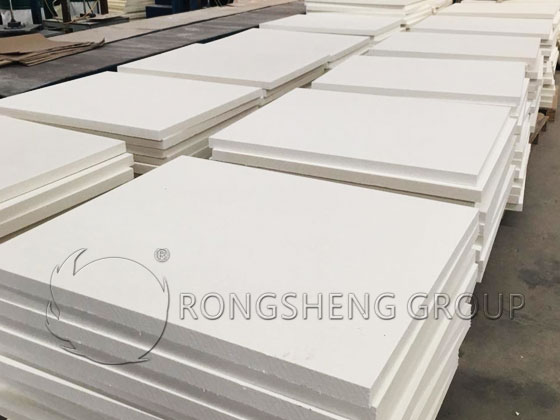
- Steel Industry: Expansion joints, backing insulation, insulation sheets, and mold insulation.
- Non-ferrous Metals Industry: Backing insulation material, tundish and runner covers for casting copper and copper alloys.
- Ceramic Industry: Lightweight kiln car structures and kiln hot face linings, kiln temperature zone separation, and fire baffles.
- Glass Industry: Molten pool backing insulation, burner blocks.
- Kiln Construction: Hot face refractory material (replaces fiber blankets), backing for heavy refractory materials, expansion joints.
- Light Industry: Linings for combustion chambers of industrial and domestic boilers.
- Petrochemical Industry: Hot face material for high-temperature heating furnace linings.
- Building Materials Industry: Thermal insulation for equipment such as cement rotary kilns.
Ceramic fiber boards can be further categorized based on their high-temperature resistance range. Therefore, users should choose the appropriate type based on the specific application and temperature resistance requirements.