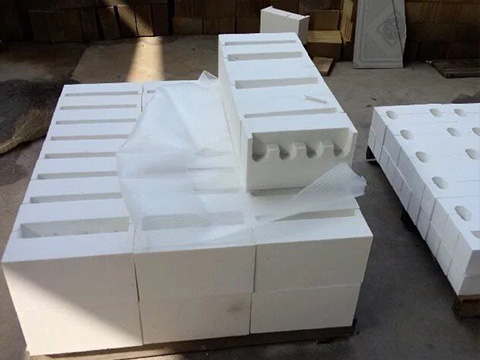
Alumina Hollow Sphere Bricks: The “Energy-Saving and Thermal Insulation Kingpin” for High-Temperature Kilns – A Comprehensive Analysis of Core Application Advantages. In high-temperature industries such as metallurgy, ceramics, chemicals, and glass, the selection of materials for kiln linings and insulation layers directly determines energy consumption, lifespan, and operational stability. Alumina Bubble bricks, with their unique hollow closed-cell structure and high-purity alumina material, have become the preferred refractory and thermal insulation material for medium- and high-temperature conditions. Compared to traditional dense bricks and lightweight insulating bricks, their advantages are concentrated in six dimensions: thermal insulation and energy saving, high-temperature resistance, thermal shock resistance, lightweighting, chemical stability, and ease of construction and maintenance. Below, we comprehensively analyze their core competitiveness from performance to application value.
Ultimate Thermal Insulation, Immediate Energy Saving and Consumption Reduction (Core Advantage)
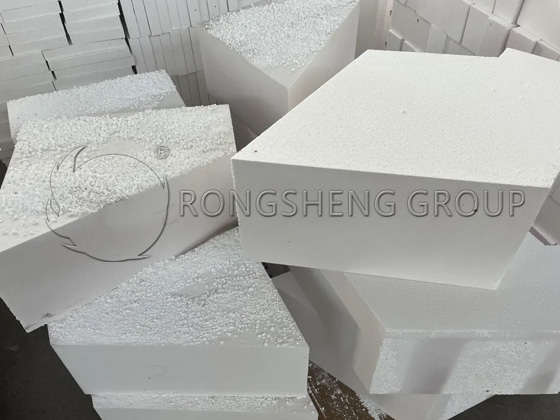
The greatest value of alumina hollow spherical bricks comes from their uniformly distributed micron-sized hollow closed-cell structure. Numerous static air layers form between the hollow spheres, completely blocking heat conduction and convection paths, resulting in extremely low thermal conductivity—only 0.2~0.4 W/(m・K) at 1000℃. The insulation effect is 3~5 times that of ordinary dense refractory bricks and more than 2 times that of ordinary lightweight bricks.
Practical Applications: Significantly reduces heat loss from the outer wall of kilns, achieving an overall energy saving rate of 25%~40%, significantly reducing fuel/electricity consumption, shortening kiln heating time, and improving thermal efficiency, perfectly meeting the industrial demands for low-carbon and cost-reduction solutions.
Applicable Scenarios: Insulation layers, backing layers, and furnace roof/wall insulation for high-temperature kilns, especially suitable for continuously operating high-temperature furnaces.
High-temperature resistance and stable load-bearing capacity, suitable for ultra-high temperature conditions
Made with high-purity alumina (α-Al₂O₃ content ≥90%), ensuring structural and performance stability at high temperatures:
Refractory temperature 1750~1800℃, long-term safe operating temperature 1500~1650℃, load softening temperature (0.2MPa) >1600℃. It does not soften, deform, or collapse at high temperatures and can be used directly as a working lining or insulation lining in medium- and high-temperature sections without the need for an additional composite dense layer.
Compared to ordinary lightweight bricks (usually used at temperatures <1300℃), alumina hollow spherical bricks can cover more demanding ultra-high temperature conditions. Suitable for metallurgical heating furnaces, ceramic shuttle kilns, glass kilns, chemical reactors, etc.
Excellent thermal shock resistance, significantly extending furnace lining life
Frequent kiln start-ups and shutdowns, and sudden temperature changes (thermal shock) are the main causes of cracking, spalling, and failure of refractory materials. The hollow, porous structure and low coefficient of thermal expansion of alumina bubble bricks effectively buffer thermal stress and inhibit crack propagation. Their thermal shock resistance (water-cooled at 1100℃) can withstand 20-30 cycles or more, far superior to dense corundum bricks and high-alumina bricks.
Practical application: They are less prone to cracking and spalling during rapid heating and cooling of the kiln, reducing the frequency of shutdowns for maintenance, extending the service life of the furnace lining by 30%-50%, and lowering maintenance costs and downtime losses.
Lightweight and high-strength, reducing furnace load and lowering infrastructure costs
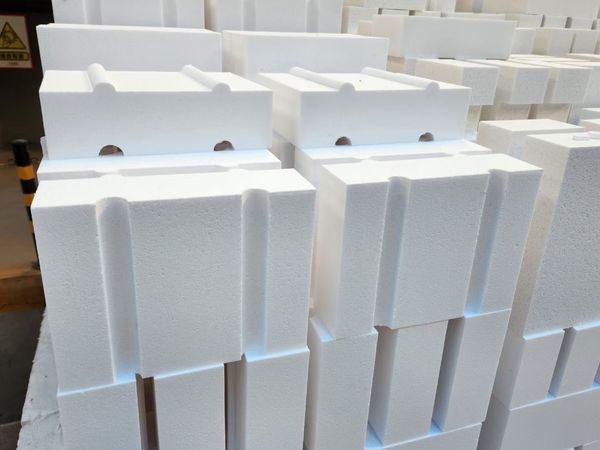
With a bulk density of only 1.0-1.8 g/cm³, which is 1/2 to 2/3 that of dense corundum bricks, they maintain good strength (compressive strength > 15MPa), achieving a balance between lightweight and high strength.
Reducing the load on the furnace steel structure and foundation, lowering the overall cost of the kiln.
Using them in the furnace roof, dome, and other parts can reduce the support structure, simplify the design, and improve furnace safety.
Easier to transport and construct, reducing construction difficulty and labor costs.
Strong chemical stability, resistant to corrosion and contamination
High-purity alumina material ensures excellent chemical corrosion resistance:
Good resistance to acids, alkalis, and molten metal/slag corrosion; does not easily react with the furnace atmosphere or materials, and causes no impurity contamination. Suitable for high-purity material firing, metallurgical refining, and high-temperature chemical reactions where high cleanliness is required. Does not crystallize or pulverize at high temperatures, maintaining structural integrity over long-term use and preventing slag contamination of products.
Construction- and-maintenance-friendly, adaptable to complex furnace types
Good processing performance: Can be cut, drilled, and customized into irregular shapes to fit curved, corner, and irregular furnace linings; small construction gaps and strong sealing.
Low thermal conductivity + good insulation: Lower furnace outer wall temperature, improving the operating environment and reducing the impact of high-temperature radiation on operators and surrounding equipment.
Easy maintenance: Local damage can be quickly repaired without complete replacement, reducing maintenance costs.
Core Application Scenarios
The advantages of alumina bubble bricks make them a standard material for the following high-temperature kilns:
Metallurgical Industry: Insulation layer/working lining for heating furnaces, soaking furnaces, annealing furnaces, and heat treatment furnaces.
Ceramics/Refractory Materials: Furnace roof, furnace walls, and regenerators for shuttle kilns, tunnel kilns, and pusher kilns.
Glass/Chemical Industry: Thermal insulation for glass melting furnaces, chemical reaction furnaces, and high-temperature pyrolysis furnaces.
Others: High-temperature electric furnaces, heat treatment equipment, and high-temperature pipeline insulation.
From thermal insulation and energy saving to high-temperature stability, from thermal shock resistance to lightweight and cost reduction, alumina hollow spherical bricks, with their comprehensive advantages of “ultra-high temperature + strong thermal insulation + long life + low cost,” have become a key material for upgrading high-temperature industrial kilns. Under the dual carbon targets, selecting alumina bubble bricks is not only a technical choice to improve kiln efficiency but also the optimal solution for enterprises to reduce costs, increase efficiency, and achieve green production.
Alumina Bubble Bricks for Metallurgical Induction Furnaces
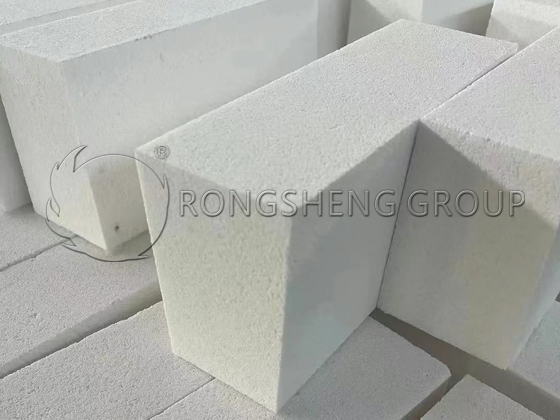
Alumina bubble bricks are used in metallurgical induction furnaces (such as medium-frequency induction furnaces, graphitization furnaces, etc.) primarily due to their lightweight, high heat insulation, and high temperature resistance characteristics. This addresses the pain points of high energy consumption, heavy furnace structure, and high thermal stress in induction furnaces, achieving energy saving, consumption reduction, and furnace body lightweighting.
Core Application Advantages of Alumina Bubble Bricks
Lightweight and Weight Reduction, Optimized Furnace Structure: Alumina bubble bricks have a low bulk density (1.1~1.8 g/cm³, only half that of traditional heavy corundum bricks), significantly reducing the furnace weight for the same volume (reducing weight by 1.1~1.9 tons/m³). This effectively reduces the load on the furnace steel structure and foundation construction costs, facilitating furnace structure modifications.
Heat Insulation and Energy Saving, Reduced Energy Consumption: Low thermal conductivity (0.3~1.2 W/(m·K)) and excellent heat insulation performance effectively reduce heat loss, achieving energy savings of over 30%. Simultaneously reduces the temperature of the furnace shell’s outer wall, improving the operating environment.
High temperature resistance and good thermal stability: Maximum operating temperature can reach 1750~1800℃, with a small reheat linear change rate (≤±0.3%) and excellent thermal shock resistance (≥15 cycles of water cooling at 1100℃). It can withstand high-frequency electromagnetic fields, high-temperature molten metal heat radiation, and sudden temperature changes, ensuring stable long-term operation of the electric furnace and extending its lifespan.
Strong chemical stability: High-purity alumina (Al₂O₃≥99%) material is very stable in the oxidizing or weakly reducing atmosphere of the induction furnace, is not easily corroded by chemicals, and has extremely low impurities, avoiding contamination of the molten metal.
Specific application areas:
Furnace body insulation layer (backing/insulation layer): Serving as the insulation lining for the side walls, furnace top, and furnace cover of the induction furnace, it is built on the back of heavy working bricks (such as dense corundum bricks) to block heat conduction and reduce the furnace shell temperature.
Working Layer (Specific Operating Conditions): In induction furnaces where there is no molten slag or direct scouring by molten metal, only high-temperature flue gas and atmosphere, it can be directly used as the working surface of the furnace lining, achieving integrated lightweighting and insulation.
Selection and Usage Recommendations
Grade Selection: For induction furnaces with long-term operating temperatures below 1650℃, 90# or 85# hollow spherical bricks can be used. If long-term operation is between 1650~1800℃, with high atmospheric requirements, or to avoid the introduction of impurities, 99# high-purity Alumina Bubble bricks must be used.
Operating Condition Suitability: Alumina hollow spherical bricks cannot be directly contacted by the strong scouring of molten steel or highly alkaline slag. Under such harsh conditions, dense corundum bricks must be used as the working surface, with the Alumina Bubble bricks only serving as a backing insulation.