Focus on Producing Quality Unshaped Refractory and Fire Bricks !
Blast Furnace Carbon Bricks Specification: Size and Shape
Carbon refractory materials for furnace linings are refractory bricks that have been calcined or graphitized, and can be broadly classified into large carbon bricks, large carbon blocks, and plastic carbon paste. Carbon bricks and blocks are further divided into graphitic (artificial graphite, natural graphite) and carbonaceous (petroleum coke, metallurgical coke, anthracite) types based on the raw materials and manufacturing processes used. Regarding carbon blocks (mainly for blast furnace and electric furnace linings): Natural graphitic carbon blocks are used for electric furnace linings. Petroleum coke and metallurgical coke carbon blocks are used as refractory lining materials for various furnaces. Anthracite-based carbon blocks are used for refractory linings of various furnaces, especially blast furnaces.
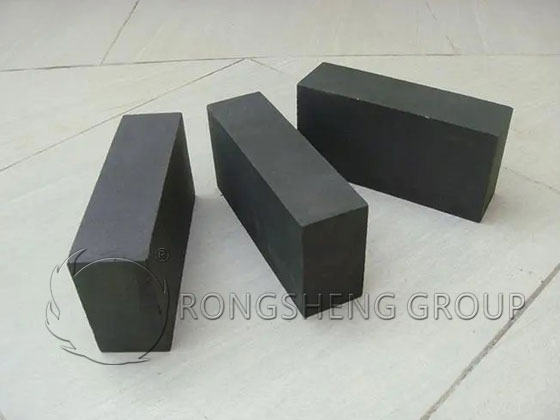
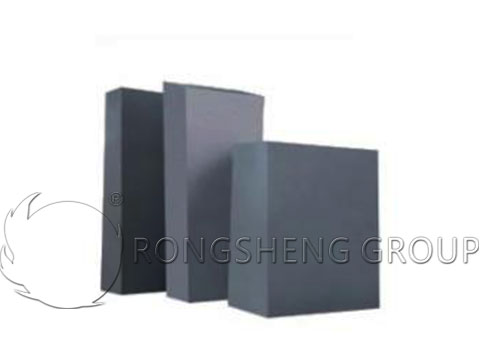
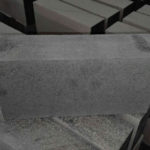
Shape of carbon bricks and blocks. Dimensions and shapes of carbon bricks. In addition to the standard carbon brick size of 65mm x 114mm x 230mm, there are also irregularly shaped carbon bricks based on this standard, such as horizontal wedge, vertical wedge, wedge, semi-thick, and fan-shaped bricks.
Dimensions of Charcoal Bricks and Blocks
The dimensions of charcoal bricks and blocks vary from country to country due to differences in manufacturing equipment, methods, and lining design. In terms of blast furnace charcoal block sizes, Germany produces large blocks of 500mm x 750mm x 2000mm, and also commonly produces smaller blocks such as 300mm x 600mm x 900mm, 300mm x 600mm x 650mm, and 300mm x 425mm x 650mm. Britain primarily uses smaller blocks of 300mm x 300mm x (380-500)mm. Conversely, the United States often uses blocks of 570mm x 760mm x 6500mm, 560mm x 760mm x 4500mm, 570mm x 730mm x 4500mm, and 570mm x 760mm x 4500mm, among others. Large carbon blocks are used for the furnace bottom, including sizes such as 300mm x 200mm x 100mm and 450mm x 280mm x 100mm. Smaller carbon blocks are used for the furnace walls. Blast furnaces use relatively large carbon blocks such as 400mm x 600mm x (1000~1300)mm, 500mm x 600mm x (1000~1300)mm, and 500mm x 700mm x (1000~1300)mm.
Shape of Carbon Bricks and Blocks
Carbon bricks and blocks generally have a lower density than the molten material in the furnace and lack a strong and effective binder. Therefore, the carbon blocks used for the furnace bottom lining sometimes float and break during use. To prevent this, the carbon blocks are made into various shapes, undergo comprehensive precision machining, and then assembled. Commonly used carbon blocks include single-wedge, double-wedge, square, and dovetail joint (wave-shaped) types.
Types and characteristics of blast furnace carbon bricks. Anthracite-based and graphite-based bricks refer to those whose main raw materials are anthracite and graphite, respectively, with a roasting temperature of 1200-1300℃. The CO furnace bottom lining uses artificial graphite. The lifespan of a blast furnace is 10-20 years. During this period, the lining material will crack, be damaged, and be consumed due to chemical corrosion, physical erosion, and thermal stress. The upper part of the blast furnace body can be repaired, but the furnace bottom lined with carbon bricks and the areas where molten iron stagnates cannot be repaired. Therefore, when designing the lining of the furnace bottom and areas where molten iron stagnates, a detailed study of the quality and shape of the materials used is necessary. The main quality characteristics of carbon bricks used in blast furnaces should meet the following criteria:
(1) Resistance to molten iron.
(2) Alkali resistance.
(3) Good mechanical properties.
(4) Heat resistance.
(5) Resistance to molten iron penetration.
Resistance to molten iron refers to the carbon’s resistance to being dissolved and consumed by molten iron. This varies among different carbon raw materials, such as anthracite, coke, artificial graphite, and natural graphite. Artificial graphite has the fastest dissolution rate. Other raw materials exhibit different dissolution rates depending on their ash content. Furthermore, adding refractory metal oxides to carbon raw materials can significantly inhibit the dissolution rate.
Alkali resistance refers to the expansion characteristics related to the penetration of alkali metals such as K and Na into the carbon block; less expansion is better. Artificial graphite also has the best reactivity with molten potassium carbonate (K₂CO₃).
Mechanical properties, heat resistance, thermal stress resistance, and fracture toughness are related and should be given due attention. Generally, carbon bricks with a thermal conductivity of 10–40 W/(m•K) are used.
Because molten iron can penetrate into the 1 μm pores of carbon bricks, the entire furnace bottom or a portion thereof uses molten iron-resistant carbon bricks (materials B, C, and D). In particular, carbon bricks of materials C and D have mostly pore diameters below a certain size, so even at 0.7 MPa, molten iron will not penetrate the carbon bricks. This resistance to molten iron erosion is achieved by inserting silicon compound tendrils into the pores of the carbon material.
Characteristics and specifications of carbon blocks as carbon refractory materials. Carbon blocks for blast furnaces, electric furnaces, and blast furnaces. Carbon blocks for electric furnaces.
A comparison of the properties of blast furnace carbon blocks and 42% Al2O3 refractory bricks published by Elliot in the UK. Its advantages are as follows:
(1) The apparent porosity of charcoal blocks is equal to that of refractory bricks, and their apparent density is lower. However, charcoal blocks have low permeability, thus resisting the intrusion of foreign components.
(2) The shrinkage rate upon reheating is roughly the same, and the softening point and load softening point of charcoal blocks are very high. Therefore, there is no need to worry about their use.
(3) Charcoal blocks do not readily react with iron, slag, alkalis, or iron oxides, nor are they wetted by any ores. Therefore, as a refractory material, they possess excellent properties.
(4) Charcoal blocks are easily oxidized at high temperatures in oxidizing atmospheres such as O2, CO2, and H2O. Therefore, they should be used in reducing atmospheres and below the oxidation initiation temperature.
(5) The phenomenon of cracking due to CO is much less common than that of refractory bricks.
(6) The coefficient of linear expansion is not significantly different from that of refractory bricks, and charcoal blocks have high thermal conductivity and excellent cooling effect.
(7) The mechanical strength and wear resistance of carbon blocks are significant. At temperatures above 1000°C, refractory bricks exhibit plasticity due to a sharp increase in vitreous volume, leading to a decrease in strength. Conversely, the mechanical strength of carbon blocks increases at high temperatures.
Initially, carbon blocks used in blast furnaces had high density and high mechanical strength. Recent research on blast furnace carbon blocks has progressed, although the mechanical strength has slightly decreased. The main focus has been on developing carbon blocks with high thermal conductivity, improving cooling efficiency, strong resistance to alkali corrosion, low permeability and porosity, and high-temperature volume stability.