Focus on Producing Quality Unshaped Refractory and Fire Bricks !
What Precautions Should be Taken When Casting Boiler Furnace?
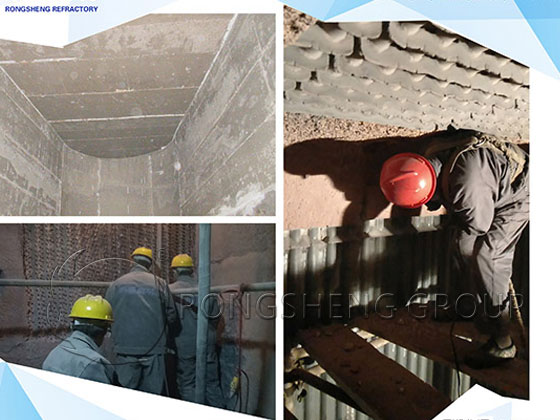
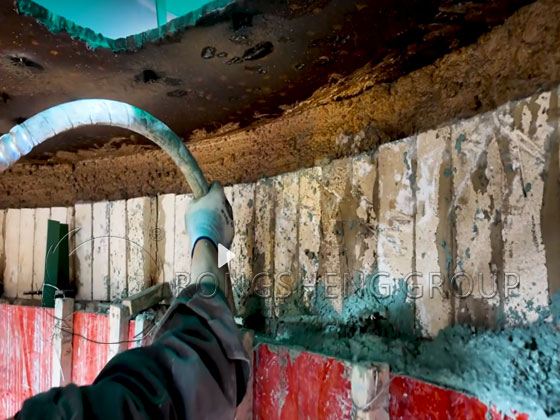
There are two primary methods for constructing boiler furnace linings: on-site brick masonry and monolithic casting. Each method presents its own advantages and disadvantages. On-site brick masonry is susceptible to expansion and contraction in response to fluctuations in furnace temperature, making it prone to cracking or structural failure. Monolithic casting entails higher production costs; however, a cast furnace lining is seamless, offers superior thermal conductivity and heat radiation efficiency, and results in minimal heat loss. For eco-friendly, energy-efficient, and low-emission coal-fired boilers, monolithic casting utilizing aluminum silicate refractory castables is a highly recommended approach.
Currently, the range of refractory castables available domestically for boiler furnace lining applications includes: aluminum silicate refractory castables, low-cement castables, phosphate-bonded refractory castables, lightweight castables, and low-cement steel-fiber-reinforced castables, among others. Regardless of the specific casting method employed, the following points must be strictly observed:
Formwork Construction: The creation of formwork is a critical stage in the process; the quality of the finished furnace lining is directly contingent upon the quality of the formwork construction. The formwork must be robust and securely braced; any “formwork creep” (shifting or deformation) will result in uneven lining thickness and inconsistent aggregate density within the material, while also causing defects such as misaligned expansion joints. The formwork must be fabricated strictly in accordance with technical drawings, ensuring precise dimensions, smooth internal surfaces, and tight, leak-proof joints.
Formwork Inspection: Construction work may commence only after the formwork has undergone and passed a formal inspection. If aluminum silicate refractory castables are being utilized, the specific proportion of high-alumina cement to be added should be determined based on prevailing site conditions and the required ambient-temperature strength of the lining.
Water Addition: For mixing the castable material, only potable water with a pH value between 6 and 8 should be used; under no circumstances should spring water be utilized. The water-to-mix ratio must be strictly controlled in accordance with the technical specifications provided by the refractory castable manufacturer; for aluminum silicate refractory castables, the recommended water content typically ranges from 5.5% to 6.5%. Adding an excessive amount of water will result in a prolonged setting time. Conversely, when using wear-resistant castables, adding too little water makes the material difficult to vibrate and consolidate, potentially resulting in voids or incomplete filling in certain areas, as well as an inconsistent material texture. During the mixing process, the water content may be adjusted slightly—within a prescribed tolerance—to account for specific variables such as the ambient temperature at the casting site and the distance over which the material must be transported.
Mixing Duration: The castable material must be mixed for a duration of 5 minutes—specifically, for no less than 5 minutes, but no more than 20 minutes. Mixed refractory castable must be used within 30 minutes; specifically, any material that has begun to stiffen must not be used. Casting of a specific component should be performed in a single, continuous operation with minimal interruption; the reuse of castable material is strictly prohibited.
Vibration and Compaction: Do not mix excessive amounts of castable at one time. If steel fibers are to be added to the castable, they must be introduced during the wet mixing process to ensure even distribution and prevent clumping. Once the castable is poured into the mold, it must be vibrated and compacted immediately. The vibrating rod should be inserted slowly into the material layer to ensure continuous vibration, aiming to expel as many air bubbles as possible. Vibration should continue until a slight layer of slurry appears on the surface; the rod should then be withdrawn slowly to prevent missed spots or the formation of voids. Ensure thorough compaction to eliminate any cavities or dead corners. In areas where standard vibration is not feasible, gently tap the formwork vertically with a hammer, or attach a round steel bar to the vibrating rod to facilitate vibration; this ensures the castable achieves a uniform texture, free from honeycomb structures or surface pitting.
For areas surrounding the furnace chamber—specifically the water-cooled walls—including material inlets, tuyeres, slag taps, gas ports, temperature/pressure measurement ports, and access manholes: ensure that compaction is performed strictly in accordance with the engineering drawings to achieve a dense structure and ensure smooth, unobstructed openings. For tuyeres, verify that the dimensions are accurate—paying particular attention to correct orientation—and ensure that the interior remains free of debris or foreign objects.
The provision of expansion joints in the castable lining is critically important, as it directly impacts the service life of the refractory material. Expansion joints must be incorporated during construction to prevent the formation of network cracks or through-cracks in the castable during the subsequent furnace drying and heating process.
High-temperature refractory materials must not be exposed to direct sunlight.
Castable Installation for the Lining of a Circulating Fluidized Bed
Technical Specifications for Refractory Castables Commonly Used in the Furnace Lining Construction of Circulating Fluidized Bed Boilers
A defining characteristic of circulating fluidized bed (CFB) boilers is the high velocity of flue gas flow, coupled with a high concentration of ash and large particle sizes within the gas stream; this subjects the furnace lining to severe erosion and abrasion. Consequently, extremely stringent requirements are imposed regarding the physicochemical properties, installation procedures, and overall construction quality of the refractory castables used for the furnace lining. Observations of CFB boilers currently in operation indicate that issues regarding the quality of furnace lining construction have become a significant limiting factor hindering the normal operation of these boilers. Substandard furnace lining construction can result in substantial economic losses for the end-user.
Requirements for Suppliers of Refractory Castables for Furnace Lining Construction
All suppliers must strictly adhere to the relevant provisions of this specification when providing refractory castables for furnace lining construction to ensure their quality meets the required standards. Furthermore, suppliers must execute the installation work in strict accordance with the prescribed process requirements to guarantee the quality of the finished furnace lining. In the event that the supplied refractory castables are found to be non-compliant with this specification—or if the quality of the installation work fails to meet the required standards—resulting in issues such as cracking, spalling, or structural collapse shortly after the boiler enters service (thereby causing economic loss to the user), the responsible supplier will be formally cited for quality non-conformance.
Implementation Requirements for Furnace Lining Construction Specifications
(1) Prior to the user placing an order for refractory castables or commencing furnace lining construction, technical personnel will be dispatched to provide a detailed explanation of this specification to both the user and the designated furnace lining construction contractor.
(2) Concurrently, input will be solicited from the refractory castable supplier (or the furnace lining construction contractor) regarding the specific construction requirements for the furnace lining in various sections of the boiler. Implementation shall proceed only after a mutual consensus has been reached. Any proposed deviations or suggestions regarding this specification submitted by the refractory castable supplier (or construction contractor) must receive formal written approval from the Technical Center—and subsequent endorsement by the user—before any modifications may be implemented. The revised documentation shall be submitted to the user for archival purposes.
(3) The refractory castable supplier (or furnace lining construction contractor) must strictly adhere to the installation procedures stipulated in this specification. Furthermore, they must ensure with absolute rigor that the final structural dimensions of the furnace lining, upon completion of construction, correspond precisely with the requirements set forth in the boiler’s design drawings. The user’s designated supervisory personnel shall conduct on-site supervision, inspection, and final acceptance procedures in strict accordance with the relevant requirements of this specification to ensure the quality of the furnace lining construction.
Technical Specifications for Common Materials Used in Furnace Wall Masonry
(1) Phosphate-Bonded Refractory Concrete
Technical Specifications for Phosphate-Bonded Refractory Concrete.
Material Delivery: Upon delivery to the user at the job site, the material shall be packaged in individual bags, and a material analysis certificate shall be provided alongside the shipment. The user shall conduct random sampling of each batch of material on-site and commission an authorized agency to perform testing to verify whether the material meets the specified requirements.
Project Test Block Requirements: During the installation of the refractory concrete, random samples shall be collected at the construction site to prepare project test blocks. A minimum of four sets of test blocks (with three blocks per set) shall be prepared, each measuring 40 × 40 × 160 mm. The curing and drying/baking procedures for these project test blocks must strictly adhere to the specific drying/baking requirements established for the boiler furnace walls.
(2)Wear-Resistant Refractory Plastic Refractory
Technical Specifications for Wear-Resistant Refractory Plastic Refractory.
Material Delivery: Upon delivery to the user at the job site, the material shall be packaged in individual bags, and a material analysis certificate shall be provided alongside the shipment. The user shall conduct random sampling of each batch of material on-site and commission an authorized agency to perform testing to verify whether the material meets the specified requirements.
Project Test Block Requirements: During the installation of the wear-resistant refractory plastic, random samples shall be collected at the construction site to prepare project test blocks. A minimum of four sets of test blocks (with three blocks per set) shall be prepared, each measuring 40 × 40 × 160 mm. The curing and drying/baking procedures for these project test blocks must strictly adhere to the specific drying/baking requirements established for the boiler furnace walls.
High-Strength Refractory Castable
Technical Specifications for High-Strength Refractory Castable.
Material Delivery Requirements: Upon delivery to the user at the job site, the material shall be packaged in individual bags, and a material analysis certificate shall be provided alongside the shipment. The user shall conduct random sampling of each batch of material on-site and commission an authorized agency to perform testing to verify whether the material meets the specified requirements.
Project Test Block Requirements: During the installation of the Zircon-Chrome Corundum castable, random samples shall be collected at the construction site to prepare project test blocks. A minimum of four sets of test blocks (with three blocks per set) shall be prepared, each measuring 40 × 40 × 160 mm. The curing and drying/baking procedures for these project test blocks must strictly adhere to the specific drying/baking requirements established for the boiler furnace walls.