Focus on Producing Quality Unshaped Refractory and Fire Bricks !
Damage Mechanism of High-Chromium Bricks Used in Different Parts of a Four-Nozzle Gasifier
Compared to the TEXACO gasifier, the four-nozzle gasifier uses four burners to spray materials (coal-water slurry and oxygen) towards the center, creating an impinging flow that results in more thorough mixing and better atomization. However, this also places higher demands on the lining materials used in the combustion chamber. This study examines the refractory materials used in various parts of a conventional four-nozzle gasifier. Through macroscopic observation and microstructural analysis of high-chromium residual bricks used in different parts of the four-nozzle gasifier, the slag erosion mechanism was investigated.
High-chromium brick residues in different parts of the four-nozzle gasifier were analyzed first to investigate the slag erosion mechanism of high-chromium bricks in different parts, providing a theoretical basis for the damage analysis of high-chromium bricks in different parts of the four-nozzle gasifier.
(1) Microstructure analysis of the arch-top brick residues.
The microstructure of the arch-top brick residues shows that the surface structure of the high-chromium bricks is loose, with interconnected pores, and a zirconium oxide missing layer of about 0.9 mm exists on the working surface.
After use, the dense chromium oxide network structure near the original layer of the brick residues has been destroyed, and the chromium oxide grains are mostly isolated. Due to the filling of the glass phase, they still maintain a relatively dense state. However, near the working surface, due to the high temperature, the low-melting phase is lost, pores are exposed, and the pores are interconnected, resulting in a very loose matrix structure.
In the early stage of alteration, obvious low-melting phases first appear in the high-chromium brick matrix, filling the spaces between the chromium oxide and aluminum-chromium solid solution crystals. As the alteration process proceeds, the low-melting phase moves closer to the working surface, and its composition and quantity change significantly. A large amount of it is lost near the working surface, resulting in numerous pores and a very loose structure.
(2) Microstructural analysis of the cylinder body brick fragments.
The microstructure of the cylinder body brick fragments reveals a dense layer of magnesium-aluminum-chromium-iron composite spinel on the surface of the high-chromium brick. EDS analysis shows its composition to be: O 41.39%, Mg 3.26%, Al 8.73%, Ca 0.48%, Cr 27.23%, Fe 18.90%. The boundary between the reaction layer and the penetration layer of the used high-chromium brick fragments is very clear. In the reaction layer, ZrO2 grains are dissolved, and the solid solution grains are separated by the infiltrated slag, resulting in isolated distribution. Slag is lost from some pores, leaving large pores.
(3) Microstructural analysis of the cone bottom brick fragments.
Microstructure analysis of the conical-bottom brick fragments revealed a 1.2 mm “zirconium-degraded layer” on the working surface. Images of the reaction layer showed a loose structure with pores mostly tens of micrometers in size. Al₂O₃-Cr₂O₃ solid solution grains were distributed singly or in groups, surrounded by molten slag. The infiltrated layer, due to slag penetration, had a denser structure than the original brick layer, with slag mainly concentrated in the matrix pores and intergranular spaces of the aluminum-chromium solid solution.
To investigate the dissolution of the high-chromium brick, EDS analysis was performed on the composition of the low-melting phase in the “zirconium-degraded layer.” The results showed that the low-melting phase in the “zirconium-degraded layer” contained 3.47% ZrO₂ and 2.01% Cr₂O₃ by mass. This indicates that during contact with coal slag, the ZrO₂ and Cr₂O₃ components of the high-chromium brick dissolved in the slag, but in very small amounts.
The above analysis shows that the chemical erosion mechanism and mode of ash on high-chromium bricks under the four-nozzle gasifier operating conditions are the same as those under the TEXACO gasifier operating conditions and laboratory conditions.
Main Applications of High-Chromium Refractory Bricks
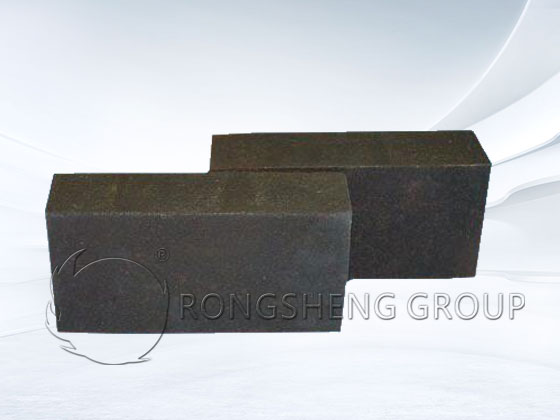
High-chromium refractory bricks were previously mainly used in reinforced glass furnaces, and to a lesser extent in insulated glass bath furnaces. Now, high-chrome bricks are increasingly being used in certain soda-lime glass bath furnaces.
Their main applications are no longer limited to all or part of the flow channels, but also include end walls and, to a limited extent, corner bricks for the charging port. Due to the composition of high-chromium bricks, there is a potential risk of coloration, so high-chromium products are generally incompatible with very “white” glass. Initially, these products were mainly used for colored glass, but now they have also been successfully used in transparent container glass bath furnaces. The amount of high-chromium bricks used in glass furnaces depends largely on the design of the flow channels, the cooling of the flow channels, the daily output of the bath furnace, and the operation of the furnace. A glass manufacturer might use high-chromium bricks for all the cover plates plus the end walls of the melting pool. Flow channels constructed with high-chromium refractory bricks offer the potential to increase furnace life because this material is at least twice as resistant to erosion of most glasses as fused AZS bricks. However, some design and operating parameters differ from those of fused AZS bricks, requiring discussion with the supplier.
Rongsheng, a high-chromium brick manufacturer, can provide technical support and furnace lining material supply based on the actual operating conditions of your high-temperature industrial furnace. Contact Rongsheng for free samples and quotations.