Focus on Producing Quality Unshaped Refractory and Fire Bricks !
Application of Low-Thermal-Conductivity Multilayer Composite Mullite Bricks in Cement Rotary Kilns
A cement company has achieved significant energy savings by using low-thermal-conductivity, multi-layer composite mullite bricks in the transition zone of its Φ4m×60m rotary kiln. Initially, these bricks were installed in the 18–38m section; after one year of operation, the bricks in the 18–28m section remained over 140mm thick, while those in the 28–38m section remained essentially intact. Prior to their use, the average kiln shell temperature exceeded 330°C; following their installation, the average shell temperature dropped below 270°C. The company subsequently extended the use of these composite bricks to the 38–48m section. During the annual maintenance inspection, the composite bricks in the 28–48m section were found to be largely intact, with the average kiln shell temperature remaining below 270°C. This article summarizes the application of these low-thermal-conductivity, multi-layer composite mullite bricks at the company.
(1) The company’s cement kiln coal consumption is relatively high, at 169.09 kg/t. The raw coal entering the plant has a moisture content of 8.57%, an ash content of 25.19%, and a calorific value of 21,330 kJ/kg. The cement kiln measures Φ4m × 60m, with a refractory lining thickness of 200 mm. In the 18–59m section of the kiln, silicon-mullite bricks are used; these have a high thermal conductivity, which—particularly in the 18–38m segment, where the average kiln shell temperature reaches 330°C—results in significant heat loss from the shell.
(2) Due to the high temperature of the kiln shell, the bearing pads of the second kiln support roller (trunnion roller) also exhibit excessively high temperatures.
Analysis of Causes and Proposed Solutions
Analysis of Causes
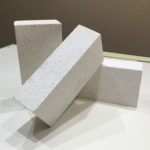
In the 18–59m section of cement kilns, silicon-mullite bricks are commonly used; they are a standard choice for the non-sintering zones of large and medium-sized rotary cement kilns. While silicon-mullite bricks offer excellent wear resistance and superior thermal shock stability, they contain a significant amount of silicon carbide—added to enhance high-temperature mechanical properties—which results in consistently high thermal conductivity and, consequently, substantial energy waste.
Proposed Solutions
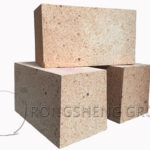
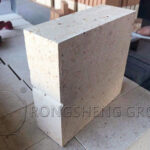
Following an evaluation, it was decided to replace the silicon-mullite bricks with low-thermal-conductivity, multi-layer composite mullite bricks.
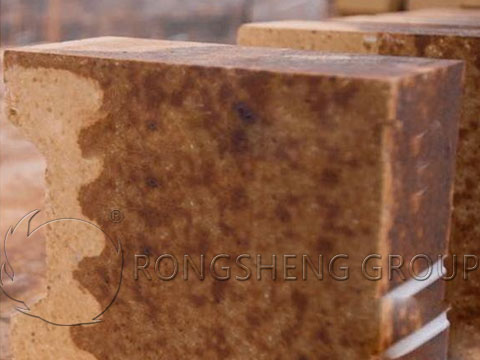
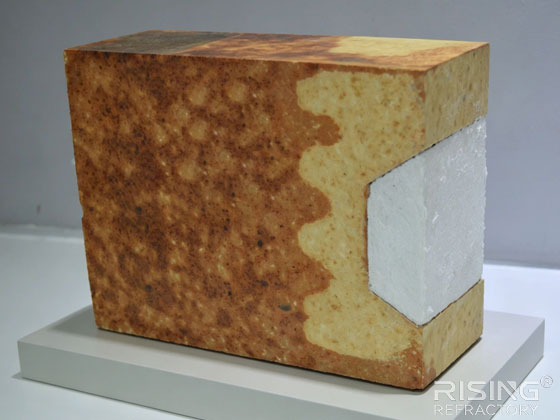
These multi-layer composite mullite bricks feature an innovative design consisting of a working layer, an insulation layer, and a thermal barrier layer, which significantly reduces thermal conductivity. The working layer utilizes M70 mullite as an aggregate and “80-grade” homogenized material as a fine powder, supplemented by 12%–15% silicon carbide and 10%–12% andalusite fine powder. This composition provides high cold crushing strength, a high load-softening temperature, and excellent thermal shock resistance. The insulation layer is primarily composed of M60 or M70 mullite; its specific alumina content ensures a high proportion of the mullite phase while remaining virtually free of the corundum phase. This layer offers lower thermal conductivity than the working layer, while maintaining strong bonding, high mechanical strength, and good wear resistance. For the thermal barrier layer, a zirconium-containing fiber board is used, as it maintains low thermal conductivity across a wide temperature range and exhibits minimal shrinkage at high temperatures. Consequently, these low-thermal-conductivity, multi-layer composite mullite bricks combine high strength, superior wear and corrosion resistance, a high load-softening temperature, and excellent thermal shock resistance—fully meeting the operational requirements of large and medium-sized rotary cement kilns. Their low-thermal-conductivity characteristic lowers the temperature of the kiln shell, reduces raw coal consumption per ton of clinker, and extends the service life of the kiln shell, thereby delivering significant socio-economic benefits to cement enterprises.
One year ago, the company replaced the silicon-mullite bricks in the 18–38m section of the kiln with low-thermal-conductivity, multi-layer composite mullite bricks. After one year of operation, the bricks in the 18–28m section retained a thickness of over 140mm, while those in the 28–38m section remained essentially intact. The average kiln shell temperature dropped from above 330°C to below 270°C. Subsequently, the company extended the application of these composite bricks by another 10 meters (covering the 28–48m section). During the annual maintenance inspection, these bricks were found to be in excellent condition, with the average kiln shell temperature remaining below 270°C. The economic benefits are as follows:
(1) Energy Savings: The reduction in kiln shell surface temperature by 50–80°C has led to a decrease in raw coal consumption of approximately 1.781 kg per ton of clinker. This translates to an annual reduction in raw coal consumption of about 1,336 tons; at a current price of 540 RMB/ton, this results in annual cost savings of approximately 721,400 RMB. Furthermore, as the low-thermal-conductivity, multi-layer composite mullite bricks are about 18 tons lighter than the original silicon-mullite bricks, the power consumption of the rotary kiln has also decreased.
(2) Emission Reduction: Saving approximately 1,336 tons of raw coal annually reduces carbon dioxide emissions by about 2,700 tons, sulfur dioxide emissions by 14.2 tons, and nitrogen oxide emissions by approximately 6 tons.
(3) Extended Refractory Service Life: With conventional refractory bricks, once the thickness wears down to 120mm, the kiln shell temperature becomes too high for continued use, necessitating replacement every six months—a process that requires shutting down the kiln for maintenance. In contrast, when the low-thermal-conductivity, multi-layer composite mullite bricks wear down to 120mm, the kiln shell temperature remains 50–80°C lower than it would be with conventional bricks, allowing for continued, safe operation.
(4) Reduced Wear on Kiln Tires and Shell Deformation: The low thermal conductivity and reduced weight of these bricks decrease the pressure-induced wear on kiln tires, as well as the rate of high-temperature deformation, oxidation, and corrosion of the kiln shell. This extends the service life of the support rollers and the kiln shell, thereby lowering maintenance costs. Although the use of low-thermal-conductivity, multi-layer composite mullite bricks entails higher direct costs compared to silicon-mullite bricks, it effectively addresses issues such as excessive kiln shell temperatures and high operating temperatures for the second-pier support roller bearings. This transition not only reduces coal consumption and the electrical power required for rotary kiln operation but also lowers emissions of carbon dioxide, sulfur dioxide, and nitrogen oxides. Furthermore, it extends the service life of the refractory lining while mitigating wear on the kiln tires and slowing the rate of kiln shell deformation. Overall, replacing silicon-mullite bricks with low-thermal-conductivity, multi-layer composite mullite bricks reduces production costs and lessens the environmental impact of the manufacturing process.
Key Advantages of Low-Thermal-Conductivity Multi-Layer Composite Mullite Bricks
Following thousands of experiments, our R&D team has successfully overcome the challenge of thermal expansion coefficient mismatches in multi-layer composite materials. By employing synchronous forming and firing techniques, we have engineered an optimal “working layer + thermal insulation layer + heat-shielding layer” structure. Each layer serves a distinct, synergistic function, reflecting a sophisticated and ingenious design:
Working Layer: Composed primarily of M70 bauxite-based sintered mullite, enhanced with additives such as silicon carbide and andalusite. This layer offers a stable structure, excellent thermal shock resistance, a high load-softening temperature, superior strength, and strong resistance to erosion and wear—ensuring reliable performance under complex, high-temperature operating conditions and extending service life.
Thermal Insulation Layer: Primarily mullite-based, with a precisely adjusted thermal expansion coefficient that aligns with the high-temperature linear dimensional changes of the working layer. It features low thermal conductivity, strong interfacial bonding with the working layer, and high compressive strength, forming a robust thermal barrier.
Heat-Shielding Layer: Crafted from low-thermal-conductivity composite materials, this layer meets stringent standards for thermal conductivity, loss on ignition, and high-temperature dimensional stability, effectively locking in heat and minimizing thermal loss.
The product achieves an overall thermal conductivity as low as 1.6–1.8 W/m·K, with a bulk density that tapers across the three layers to 2.4–2.5 g/cm³. This design effectively reduces heat loss and fuel consumption in kilns, while simultaneously lightening the load on equipment and extending maintenance intervals—delivering a triple benefit: energy conservation, consumption reduction, and equipment protection.