Focus on Producing Quality Unshaped Refractory and Fire Bricks !
What Raw Materials Can Significantly Enhance the Acid Resistance of Castables?
Pyrolytic carbonization is a treatment process in which organic components undergo pyrolysis at high temperatures in an oxygen-free environment, ultimately yielding solid carbonaceous products. During this process, significant quantities of strongly acidic gases—such as nitrogen oxides, sulfur oxides, carbon oxides, hydrogen chloride, and hydrogen fluoride—are generated. Combined with high-temperature water vapor, these gases cause severe erosion to the lining of the carbonization furnace. Consequently, the castable refractories used for such linings must possess excellent resistance to high-temperature acid erosion, adequate mechanical strength, low thermal conductivity, and superior thermal shock resistance.
Which raw materials can significantly enhance the acid resistance of these castables?
To achieve an optimal balance of strength, erosion resistance, and thermal conductivity, existing research has utilized mullite and brown fused alumina as primary raw materials. By incorporating silicon carbide and hollow alumina spheres, a lining material with low thermal conductivity and high resistance to acid erosion has been developed. To further improve the strength and acid resistance of the castable—tailored to the specific operating conditions and performance requirements of carbonization furnace linings—research was conducted on the effects of adding silicon powder and carbon black, building upon a base formulation containing 15 wt% hollow alumina spheres (1–0.2 mm) and 8 wt% silicon carbide powder (≤0.074 mm).
Raw Materials
The primary raw materials used in the experiments included: electrofused mullite (density: 2.71 g·cm⁻³; particle sizes: 8–5, 5–3, 3–1, ≤1, and ≤0.074 mm); brown fused alumina (density: 3.90 g·cm⁻³; particle sizes: ≤1 and ≤0.08 mm); silicon carbide (particle size: ≤0.074 mm); and alumina hollow spheres (particle size: 1–0.2 mm). Other materials included α-Al₂O₃ micropowder, kyanite (particle size: 0.55–0.18 mm), silica micropowder, pure calcium aluminate cement, silica fume (≤0.074 mm), and carbon black powder. Additives consisted of a polyphosphate water-reducing agent and organic fibers (used as an anti-explosive/spalling agent).
Experimental Procedure and Performance Testing
The raw materials were mixed thoroughly in specific proportions, combined with water, and cast into specimens—measuring 40 mm × 40 mm × 160 mm and φ180 mm × 30 mm—using vibration molding. The specimens were cured at room temperature for 24 hours before being demolded. They were then subjected to drying at 110°C for 24 hours, followed by heat treatment in a reducing atmosphere at 1100°C for 3 hours and 1350°C for 3 hours. The bulk density, compressive strength, flexural strength, and linear change rate of the specimens were subsequently measured. Acid resistance was evaluated by exposing the specimens to a nitric acid solution.
Conclusions
(1) Silica fume has a minimal effect on the strength of the acid-resistant castable specimens at 110°C. At 1100°C, the silica fume begins to undergo oxidation. At 1350°C, significant reaction sintering occurs, leading to an increase in both the bulk density and the linear shrinkage of the specimens; this effect outweighs the expansion caused by the mullitization of kyanite. Under the experimental conditions, the optimal addition level of silica fume is approximately 2.5% (by weight).
(2) When treated at temperatures of 110°C and 1100°C, the addition of carbon black leads to a reduction in the strength of acid-resistant castables, as it necessitates an increase in the amount of water required for the mix. At a treatment temperature of 1350°C, however, carbon black reacts with silica fume, which serves to enhance the material’s strength. While the inclusion of carbon black improves the acid resistance of the castables, an excessive amount leads to an increase in porosity. Experimental results indicate that an addition of 1.5 wt% carbon black yields an optimal balance of strength and acid resistance in the acid-resistant castables.
Functions and Scope of Application for Acid-Resistant Castables
Acid-resistant castables are categorized into heavy-duty, semi-lightweight, and lightweight types; they are primarily used for furnace linings that must withstand acid corrosion. These castables are typically bonded with acid-resistant cement and are used in applications such as the linings of acid-resistant chimneys and liquid sulfur storage tanks in the petrochemical industry.
Acid-resistant castables are designed for acidic environments. During production, raw materials—which are themselves acidic—are processed into granules and fine powders, to which specific proportions of ultrafine powders and additives are incorporated. However, these castables should not be used in environments subject to significant temperature fluctuations, nor should they be installed in excessively damp conditions. Inappropriate temperature conditions can compromise the material’s long-term structural strength and acid resistance, potentially leading to spalling.
For instance, semi-lightweight acid-resistant castables are commonly used for chimneys, as they provide thermal insulation while simultaneously resisting corrosion and erosion from acidic gases. These materials help conserve energy, improve the operational efficiency and service life of chimneys, and ensure that the overall weight of the chimney structure remains manageable.
Scope of Application
Acid-resistant castables are designed exclusively for furnace linings exposed to acidic environments; they are unsuitable for use in neutral or alkaline atmospheres. This is because their high-temperature resistance is inferior to that of high-alumina castables (used in neutral environments) and magnesia-based castables (used in alkaline environments). These materials are primarily employed for lining chimneys, flues, nitric acid concentration towers, and vessels containing acidic gases.
Nevertheless, acid-resistant castables can serve effectively as standalone lining materials, provided the furnace environment remains consistently acidic—a condition under which they can fully leverage their inherent acid-resistance. They should not be used in furnaces with different atmospheric conditions. This limitation stems from differences in both high-temperature performance and resistance to corrosion by non-acidic substances. In short, regardless of whether they are classified as heavy-duty, semi-lightweight, or lightweight, acid-resistant castables must be used solely for linings exposed to acidic gases.
Silicon Carbide Wear-resistant Castable in RS Factory
What types of refractory castables with special properties are there?
Refractory castables with special properties include wear-resistant, acid-resistant, alkali-resistant, impermeable, and high-thermal-conductivity refractory castables.
Wear-resistant castables
Wear-resistant castables are dense and hard; they utilize multi-stage particle gradation, resulting in a high bulk density. Formulated with high-quality binders, ultrafine powders, and additives, they exhibit high compressive strength and excellent wear resistance. They are used for applications such as skid rails in steel-rolling heating furnaces and as linings for boilers in the power industry. There are various methods for testing the wear resistance of these castables, and results from different methods are generally not comparable. However, when the raw materials and testing methods are identical, one can effectively evaluate and compare their relative wear resistance.
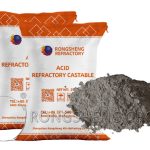
Acid-resistant refractory castables are formulated using water glass or cement as a binder, combined with siliceous materials and a small amount of aluminosilicate materials. They perform well in acidic environments at low to medium temperatures. Such castables are frequently used for protective layers in blast furnaces and hot-blast stoves, as well as for linings in steel chimneys and flues.
In water glass-bonded acid-resistant castables, exposure to low-concentration acid solutions can disrupt the bonds between aggregates, leading to a reduction in strength. Conversely, highly viscous acid solutions do not penetrate as easily and can actually enhance chemical strength. Silica gel facilitates the development of strength within the castable. Furthermore, if an acid solution is introduced into the castable, its strength does not diminish.
Cement-bonded acid-resistant castables are primarily used for chimney linings and can also be applied via spraying as acid-resistant gunning mixes.
Alkali-Resistant Castables
Alkali-resistant castables are formulated using aluminosilicate raw materials and calcium aluminate cement; they are available in both dense (heavyweight) and lightweight varieties. They are primarily used in the preheaters and ductwork of large- and medium-sized cement rotary kilns. Alkali-resistant castables bonded with sodium silicate (water glass) also exhibit excellent alkali resistance, effectively countering erosion from molten sodium salts. These are frequently used for lining alkali recovery furnaces in the pulp and paper industry, where they perform quite well. Another category of alkali-resistant castables includes magnesia-based (magnesite) castables, which are suitable for high-temperature zones within alkaline furnace linings.
Impermeable (Anti-Seepage) Castables
Impermeable castables are designed for use in aluminum electrolytic cells and are classified as mid-to-low-grade castables.
High-Thermal-Conductivity Refractory Castables
High-thermal-conductivity refractory castables are typically silicon carbide-based. They are characterized by high thermal conductivity and a low coefficient of thermal expansion, while also offering good thermal shock resistance, high mechanical strength, and excellent wear resistance.